
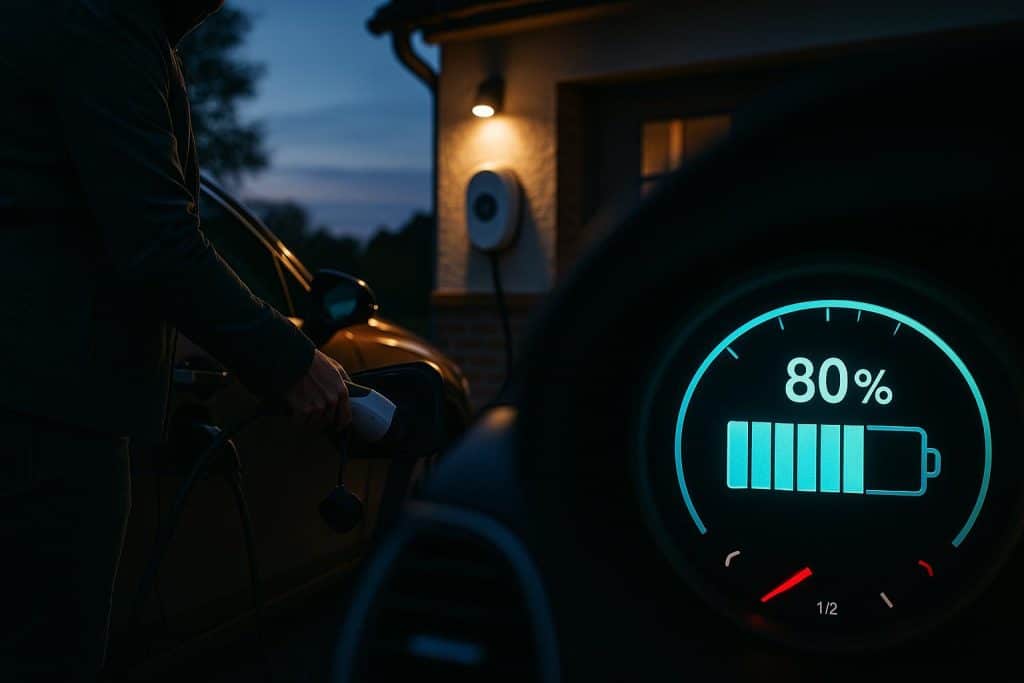
The “80% charge rule” in plain terms
The 80% charge rule is the idea that you should avoid routinely charging an EV beyond about 80% and, in particular, avoid leaving it sitting at a high state of charge for long periods. It’s often presented as a hard rule, but in reality it’s a useful guideline that depends on your battery chemistry, your driving needs, and how your car is parked and charged day to day.
Why high charge levels can accelerate battery ageing
Most EVs use lithium-ion batteries. These cells age in two main ways: through cycling (charging and discharging) and through calendar ageing (time passing). High states of charge increase the battery’s internal voltage, and higher voltage tends to speed up chemical reactions that slowly reduce capacity over time. In practical terms, keeping a battery near “full” for extended periods can be more stressful than keeping it at a moderate level.
Heat compounds this effect. A battery sitting at a high state of charge in warm conditions is generally under more stress than the same battery at a mid-range charge and cooler temperature. This is one reason the “don’t leave it at 100%” advice has stuck around: it reflects how lithium-ion chemistry behaves, even if the real-world impact varies by vehicle and climate.
So is 80% the magic number?
Not exactly. 80% is a convenient, easy-to-remember threshold that keeps most daily use away from the highest-voltage region of the battery. But the precise “sweet spot” is not identical across all EVs, and it is not a cliff edge where 81% suddenly becomes harmful. Think of it as a sliding scale: the higher the state of charge and the longer it stays there, the more potential for faster ageing.
Some manufacturers explicitly recommend daily charging to around 80% or 90% (often via a charge limit setting). Others design the battery management system so that the displayed 100% is not the absolute maximum of the cells, leaving a buffer at the top. That buffer can reduce stress, but it does not make the battery immune to time spent at high charge.
What the research and real-world data generally supports
Across laboratory studies and fleet experience, a consistent pattern emerges: avoiding prolonged high state of charge helps reduce long-term capacity loss. The effect is typically gradual rather than dramatic, and many drivers will never notice a day-to-day difference. However, over several years, especially for drivers who keep their cars for the long haul, the habit of charging to a lower daily limit can be a sensible way to preserve range and performance.
Just as importantly, the “for long periods” part matters. Charging to 100% for a trip and then driving soon after is not the same as charging to 100% and leaving the car parked for days in warm weather. The former is normal use; the latter is where the guidance becomes most relevant.
When charging above 80% makes perfect sense
There are plenty of good reasons to charge beyond 80%, and doing so occasionally is not a problem for most owners:
• Road trips and long days out: If you need the extra range, use it. Many EVs also charge more slowly above about 80% on rapid chargers, so you may naturally spend less time in that upper band on the road, but for destination charging it can be worth going higher.
• Limited home charging windows: If you only have access to off-peak rates for a short period, you might choose a higher target to reduce how often you need to plug in.
• Cold weather planning: Winter range can drop, and a higher starting charge can add useful buffer for unexpected detours or slower traffic.
• Manufacturer guidance: If your car’s handbook recommends a particular routine (including higher daily limits), follow that first. The battery management system is designed around those assumptions.
When the 80% guideline is most worth following
The guideline has the most value if your typical day uses only a small portion of the battery and the car spends long stretches parked:
• Daily commuting with plenty of range spare: If you regularly finish the day with a large buffer, charging to 70–80% can be an easy win.
• Cars left parked for days: If you are going away or not driving much, it is better to store the battery at a moderate charge rather than near full.
• Warm conditions and outdoor parking: Heat plus high state of charge is a less friendly combination. If you cannot avoid the heat, lowering the target charge can help.
Practical charging habits that work for most drivers
Use the charge limit setting. If your EV lets you set a daily limit (often 80% or 90%), use it for routine charging. It removes the mental load and keeps your battery in a comfortable operating range.
Time your charge to finish close to departure. If you do want a higher charge, scheduling the car to finish charging shortly before you leave reduces the time spent sitting at a high state of charge.
Avoid leaving it at 100% unnecessarily. If you charge to full for a trip, try to set off soon after rather than letting it sit full overnight for no reason.
Do not obsess over occasional exceptions. Battery ageing is influenced by many factors, and modern EVs are built to handle real life. The goal is a sensible routine, not perfection.
What about 90% instead of 80%?
For many drivers, 90% is a practical compromise, especially if your EV’s range is modest or you do a lot of motorway miles. The difference between 80% and 90% is not “safe versus unsafe”; it is simply a trade-off between convenience and minimising time at higher voltage. If 80% creates range anxiety or forces too many charging sessions, a higher daily limit can be the better overall choice.
Key takeaway
The 80% charge rule is fact in principle, fiction as a strict rule. Avoiding long periods at high state of charge can meaningfully support long-term battery health, but it is a flexible guideline, not a hard limit. Use 80% (or 90%) for everyday charging if it suits your routine, and charge to 100% when you genuinely need the range, ideally timing it so the car does not sit full for long.
For more EV news, charging and battery updates, and trip inspiration, take a look around Epic EV Explorer and see what’s new.
